
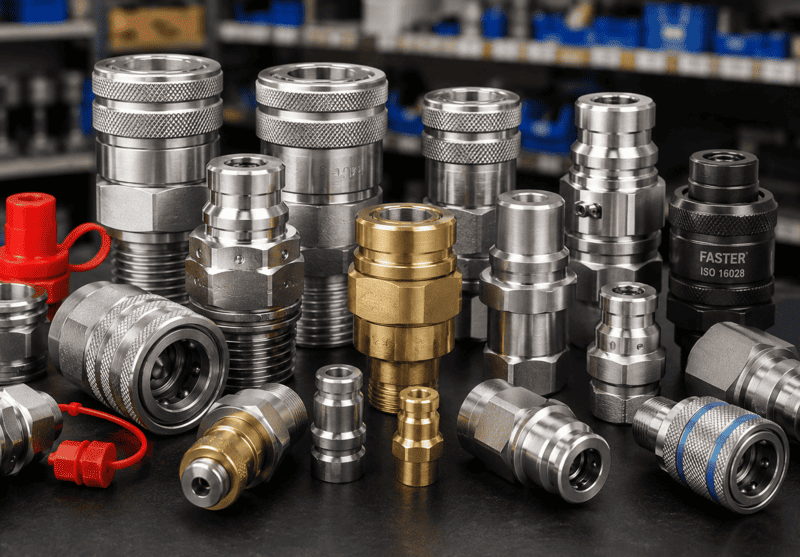
Quick Release Couplings
In industrial fluid transfer systems, speed and reliability are equally important. Whether it is hydraulic machinery, pneumatic equipment or mobile industrial systems, operators often need a way to connect and disconnect lines quickly without creating leakage or operational delay. This is where Quick Release Couplings become extremely useful.
In many industries, these couplings are not just convenience components anymore. They directly affect maintenance time, system safety and operational efficiency. A properly selected coupling helps reduce downtime, prevents unnecessary oil loss and improves overall equipment handling.
At Hydrofit Engineers, we work with industries requiring dependable hydraulic and pneumatic flow connection solutions across India. From standard hydraulic systems to high pressure industrial applications, quick release couplings are now a regular requirement across multiple sectors.
Understanding Quick Release Couplings
A quick release coupling, also called a quick disconnect coupling, is designed to connect fluid or air lines without requiring complicated tools or lengthy installation procedures.
The main purpose is simple:
- quick connection
- quick disconnection
- minimal leakage
- safe fluid handling
These couplings are widely used in hydraulic systems, compressed air lines, industrial machinery and mobile equipment where operational speed matters.
Industries looking for a reliable Quick Release Couplings supplier in India generally prefer products that can handle pressure, vibration and repeated usage without affecting sealing performance.
Why Industries Prefer Quick Release Couplings
In practical industrial environments, maintenance teams cannot afford long shutdown periods just to disconnect hydraulic lines. Traditional threaded fittings increase maintenance time and often create leakage issues during removal.
Quick release couplings simplify this process significantly.
Some of the major reasons industries prefer them include:
- Faster maintenance handling
- Reduced fluid leakage
- Easy connection and disconnection
- Better operational safety
- Reduced downtime
- Improved flexibility in hydraulic systems
This is why industries searching for the Best Quick Release Couplings in India often focus on durability and sealing reliability rather than only pricing.
Types of Quick Release Couplings
Different applications require different coupling designs. Selecting the correct type mainly depends on pressure range, media compatibility and operational conditions.
Hydraulic Quick Release Couplings
Hydraulic couplings are designed for fluid transfer systems operating under pressure. These couplings are commonly used in construction equipment, hydraulic power packs and industrial machinery.
Industries working with hydraulic systems often use Hydraulic Quick Release Couplings for fast hydraulic line connection and maintenance.
Pneumatic Quick Release Couplings
Pneumatic couplings are mainly used in compressed air systems and pneumatic tools where quick air line connection is required.
Compared to hydraulic couplings, pneumatic couplings generally operate at lower pressure levels.
Industrial air systems commonly use Pneumatic Quick Release Couplings for operational convenience and faster tool handling.
Single Check Valve QRC Couplings
Single check valve couplings include an internal valve on one side of the coupling. When disconnected, the valve automatically shuts off fluid flow from one side, helping reduce leakage.
These are widely used in hydraulic systems where controlled fluid handling is required.
Double Check Valve Quick Release Couplings
Double check valve couplings include shut off valves on both sides of the connection. This design helps minimize fluid loss during disconnection.
Industries handling high pressure hydraulic systems often use Double Check Valve Quick Release Couplings where leakage control is important.
ISO Standard Quick Release Couplings
Many industrial buyers prefer ISO standard couplings because they ensure dimensional compatibility and interchangeability across systems.
ISO 7241 A Quick Release Couplings
These couplings are commonly used in agricultural and industrial hydraulic applications where standard interchangeability is required.
Hydraulic systems in agriculture and machinery applications often use ISO 7241 A Quick Release Couplings for reliable hydraulic connectivity.
ISO 7241 B Quick Release Couplings
ISO 7241 B series couplings are generally preferred in industrial hydraulic systems requiring stronger sealing and industrial compatibility.
Industries handling process equipment and industrial hydraulic lines commonly use ISO 7241 B Quick Release Couplings in pressure applications.
ISO 16028 Quick Release Couplings
ISO 16028 couplings are flat face couplings designed to reduce fluid spillage and contamination during operation.
Applications involving sensitive hydraulic systems commonly use ISO 16028 Quick Release Couplings for cleaner hydraulic performance.
Material Selection in Quick Release Couplings
Material selection plays a major role in coupling life and sealing reliability.
Stainless Steel Quick Release Couplings
Stainless steel couplings are preferred in corrosive environments and industries involving moisture, chemicals or outdoor operation.
Industrial buyers looking for corrosion resistant solutions generally prefer Stainless Steel Quick Release Couplings for long term durability.
Brass Quick Release Couplings
Brass couplings are commonly used in pneumatic, water and low pressure applications because of their corrosion resistance and cost effectiveness.
They are widely used in general industrial and utility systems.
Applications of Quick Release Couplings
Quick release couplings are used across multiple industries because they simplify operational handling and reduce maintenance effort.
Common applications include:
- Hydraulic machinery
- Pneumatic systems
- Agriculture equipment
- Construction machinery
- Industrial automation systems
- Oil and gas applications
- Manufacturing plants
- Mobile hydraulic equipment
In agriculture, quick release systems improve attachment handling and hydraulic line replacement speed.
How to Select the Right Quick Release Coupling
Choosing the correct coupling depends on several operational factors.
Industrial buyers generally consider:
- Operating pressure
- Fluid compatibility
- Material selection
- Temperature range
- Connection size
- Leakage control requirement
- ISO compatibility
A coupling selected only based on size may create long term operational issues if pressure and sealing requirements are ignored.
This is why industries often prefer experienced Hydraulic Couplings supplier in Chennai who understand actual industrial applications.
Maintenance Tips for Long Service Life
Even good quality couplings require periodic inspection to maintain proper performance.
Some practical maintenance practices include:
- Keep coupling surfaces clean
- Avoid dust contamination during connection
- Inspect seals regularly
- Replace worn locking mechanisms
- Avoid pressure overload conditions
Regular maintenance helps improve coupling life and reduces unexpected hydraulic failures.
Why Industrial Buyers Prefer Reliable Suppliers
In industrial applications, buyers are no longer searching only for products. They look for suppliers who understand operating conditions and application requirements.
Hydrofit Engineers supplies industrial coupling solutions for hydraulic and pneumatic systems across different industries in India. As a growing Quick Release Couplings manufacturer in Chennai, we support industries requiring dependable fluid connection products for practical industrial use.
Final Thoughts
Quick release couplings have become an important part of modern hydraulic and pneumatic systems. Their ability to improve maintenance speed, reduce leakage and simplify operation makes them valuable across industrial applications.
For industries looking for dependable Industrial Quick Release Couplings dealer in India, Hydrofit Engineers supplies practical hydraulic and pneumatic coupling solutions designed for demanding industrial environments.