Contact : +91-79045 61980 | Email: hydrofitengineers@gmail.com

Quick Release Couplings: What They Are, How They Work & Best Uses (2026 Guide)
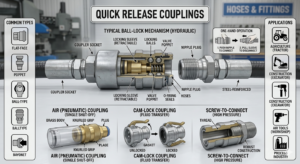
In industries where speed, safety, and efficiency are critical, quick release couplings play a vital role. These small yet powerful components simplify the process of connecting and disconnecting fluid or gas lines without the need for tools. Whether used in hydraulic systems, pneumatic applications, or fluid transfer setups, quick couplings enhance productivity while minimizing downtime.
What Are Quick Release Couplings?
Quick release couplings, also known as quick disconnect couplings, are mechanical devices designed to connect and disconnect fluid lines quickly and easily. They eliminate the need for threading, tightening, or specialized tools, making them highly efficient in fast-paced environments.
These couplings are commonly used in systems involving:
- Hydraulic fluids
- Compressed air
- Water transfer
- Chemical handling
- Gas distribution
They consist of two main parts:
- Male plug (nipple)
- Female socket (coupler)
When connected, they form a secure, leak-proof seal. When disconnected, built-in valves often prevent fluid leakage.
How Do Quick Release Couplings Work?
The working mechanism of quick release couplings is simple yet highly effective. Most couplings use a push-to-connect and pull-to-release system.
Basic Working Principle:
- The male plug is inserted into the female socket.
- Internal locking mechanisms (such as balls or sleeves) secure the connection.
- Valves inside open automatically, allowing fluid or gas to flow.
- When disconnected, the valves close instantly to prevent leakage.
This design ensures:
- Minimal fluid loss
- Reduced contamination
- Safe and fast operation
Types of Quick Release Couplings
Choosing the right coupling depends on your application. Below are the most commonly used types:
1. Hydraulic Quick Release Couplings
These are designed for high-pressure hydraulic systems. They are widely used in construction equipment, agricultural machinery, and industrial machinery.
Features:
- High pressure resistance
- Leak-proof design
- Durable materials like steel or brass
2. Pneumatic Quick Couplings
Used in compressed air systems, pneumatic couplings are lightweight and easy to operate.
Applications:
- Air tools
- Automation systems
- Manufacturing units
3. Dry Break Couplings
Dry break couplings are designed to prevent spillage during disconnection. They are ideal for handling hazardous or expensive fluids.
Benefits:
- Zero spillage
- Environmental safety
- Reduced product loss
4. Camlock Couplings (Cam and Groove)
These couplings are widely used in fluid transfer applications and are known for their ease of use.
Common uses:
- Oil and gas industry
- Chemical processing
- Water transfer
5. Flat Face Couplings
Flat face couplings minimize fluid loss and prevent air inclusion in hydraulic systems.
Advantages:
- Easy cleaning
- Reduced contamination
- Ideal for clean environments
Key Benefits of Quick Release Couplings
Quick release couplings offer several advantages that make them indispensable in modern industrial systems.
1. Time Efficiency
They allow for rapid connection and disconnection, significantly reducing downtime.
2. Enhanced Safety
Automatic shut-off valves prevent leaks and spills, reducing workplace hazards.
3. Ease of Use
No tools are required, making them user-friendly even for non-technical operators.
4. Versatility
Suitable for a wide range of industries, including automotive, agriculture, manufacturing, and chemical processing.
5. Reduced Maintenance
High-quality couplings are durable and require minimal maintenance over time.
Applications of Quick Release Couplings
Quick release couplings are used across multiple industries due to their flexibility and reliability.
Industrial Manufacturing
Used in assembly lines, robotics, and automated systems for fluid and air transfer.
Agriculture
Essential for connecting hydraulic lines in tractors and farming equipment.
Automotive Industry
Used in fuel lines, coolant systems, and brake systems.
Chemical Industry
Ensures safe handling of hazardous chemicals with leak-proof connections.
Construction Equipment
Widely used in heavy machinery like excavators and loaders.
How to Choose the Right Quick Release Coupling
Selecting the right coupling is crucial for performance and safety. Here are the key factors to consider:
1. Pressure Rating
Ensure the coupling can handle the maximum operating pressure of your system.
2. Material Compatibility
Choose materials that are compatible with the fluid or gas being transferred.
Common materials include:
- Stainless steel (corrosion resistance)
- Brass (cost-effective)
- Aluminum (lightweight)
3. Size and Flow Rate
Select a coupling that matches your system’s flow requirements to avoid pressure drops.
4. Connection Type
Consider whether you need threaded, push-to-connect, or camlock connections.
5. Environmental Conditions
For harsh environments, choose couplings that resist corrosion, temperature extremes, and contamination.
Maintenance Tips for Quick Release Couplings
Proper maintenance ensures long-lasting performance and prevents system failures.
- Regularly inspect for wear and tear
- Clean couplings to prevent contamination
- Lubricate moving parts if required
- Replace damaged seals immediately
- Store in a clean, dry environment
Common Problems and Solutions
Leakage Issues
Cause: Worn seals or improper connection
Solution: Replace seals and ensure proper alignment
Difficulty in Connection
Cause: Dirt or debris inside the coupling
Solution: Clean thoroughly before use
Pressure Drop
Cause: Incorrect size or blockage
Solution: Choose appropriate size and inspect for obstructions
Future Trends in Quick Release Couplings
The industry is evolving with innovations aimed at improving efficiency and sustainability.
Smart Couplings
Integration with sensors for monitoring pressure, temperature, and flow.
Eco-Friendly Designs
Development of couplings that minimize fluid loss and environmental impact.
Advanced Materials
Use of high-performance composites for better durability and lightweight performance.
Why Quality Matters in Quick Release Couplings
Investing in high-quality couplings ensures:
- Better performance
- Longer lifespan
- Enhanced safety
- Lower maintenance costs
A reliable manufacturer like Hydrofit Engineer ensures precision-engineered couplings designed to meet industrial standards and deliver consistent performance.
Conclusion
Quick release couplings are essential components in modern fluid and gas transfer systems. Their ability to provide fast, secure, and leak-proof connections makes them invaluable across various industries. From hydraulic machinery to pneumatic tools, these couplings improve efficiency, safety, and overall system performance.
By understanding the different types, benefits, and selection criteria, you can choose the right quick release coupling for your specific needs. As technology continues to advance, these components will become even more efficient, reliable, and environmentally friendly.
FAQs
What are quick release couplings used for?
Quick release couplings are used to quickly connect and disconnect fluid or gas lines in systems like hydraulic, pneumatic, and chemical transfer applications.
Are quick release couplings leak-proof?
Yes, most quick release couplings are designed with built-in valves that prevent leakage during disconnection.
How do I choose the right quick coupling?
Consider factors like pressure rating, material compatibility, size, and environmental conditions.
What is the difference between hydraulic and pneumatic couplings?
Hydraulic couplings handle high-pressure fluid systems, while pneumatic couplings are used for compressed air systems.